
Strengthening Global Data for School Meals: GCNF and the World Bank Collaborate to Elevate School Feeding in Global Dashboards
Blog co-authored by the Global Child Nutrition Foundation (GCNF) and the World Bank, with primary individual contributions from Alissa Rutkowski, Communications Officer, GCNF; Ayala Wineman, Research Scientist, GCNF; Claudia Rodríguez Alas, Senior Social Protection Specialist, the World Bank; Mia Blakstad, Social Protection Specialist, the World Bank; Dina Mohammed Aburmishan, Nutrition Specialist, Consultant, the World Bank; Namesh Nazar, Agriculture Economist, the World Bank.
For many children, a school meal is the only nutritious meal they will receive throughout the day.
School meal programs help keep children in the classroom, support their health and wellbeing, and ease the financial strain on families. Far beyond a social safety net, these programs are a smart investment in education, health, and equity for the next generation.
To ensure that school meal programs are effective, governments need to understand their true impact. How many children are receiving meals? Are girls and boys benefiting equally? Are the programs reaching those who need them most? Answering these questions requires accurate, reliable data to guide decision-making.
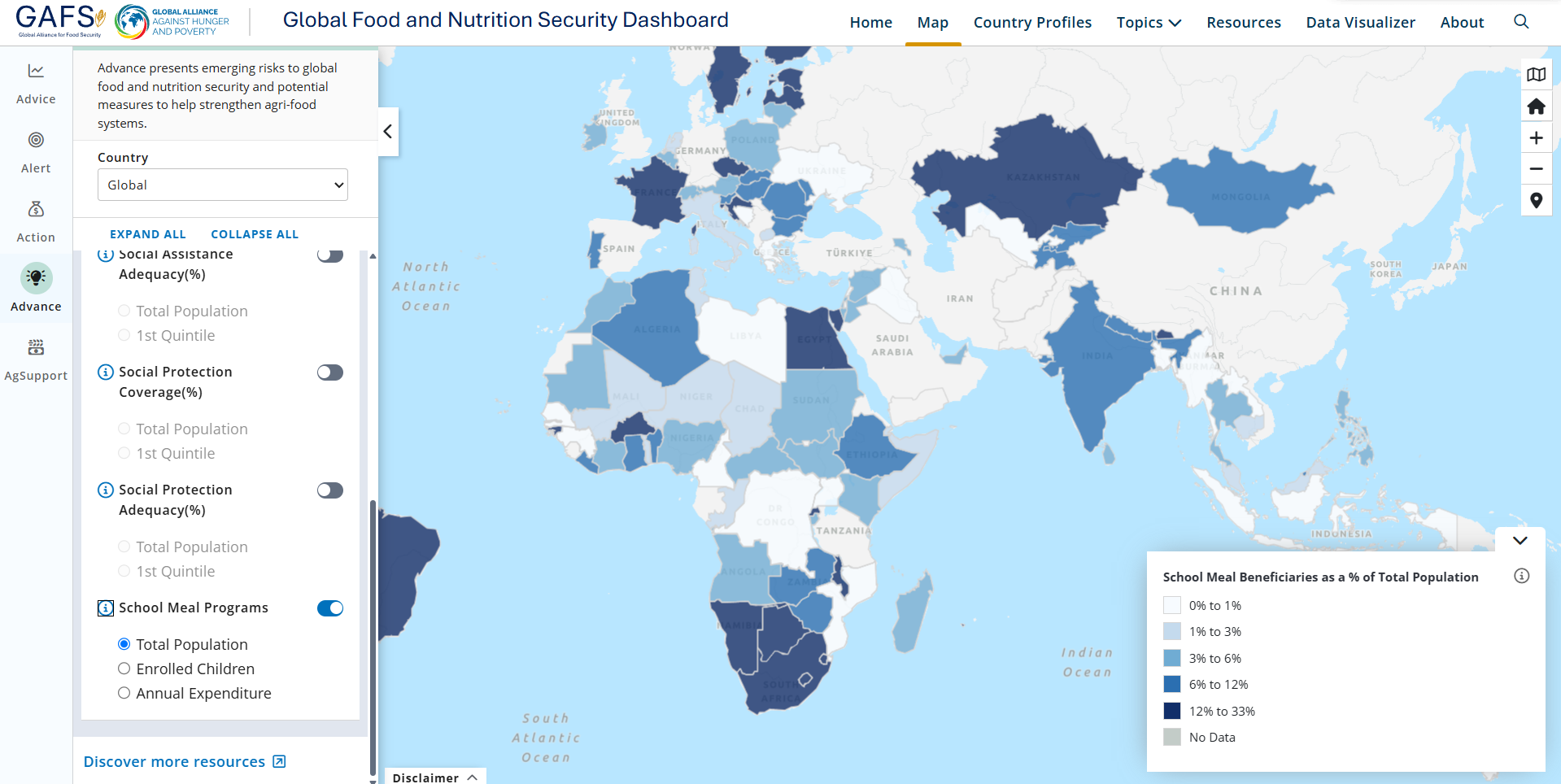
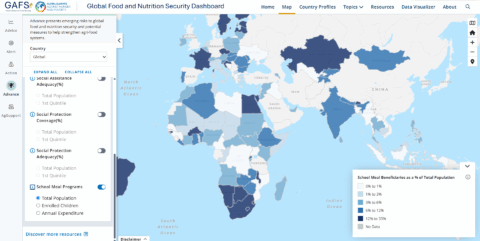
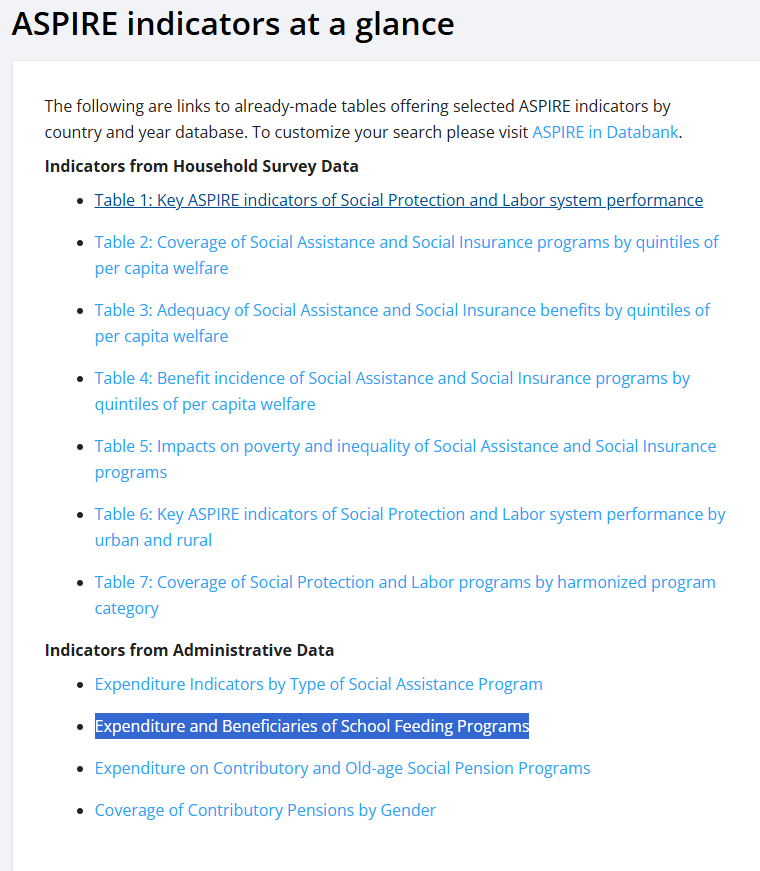
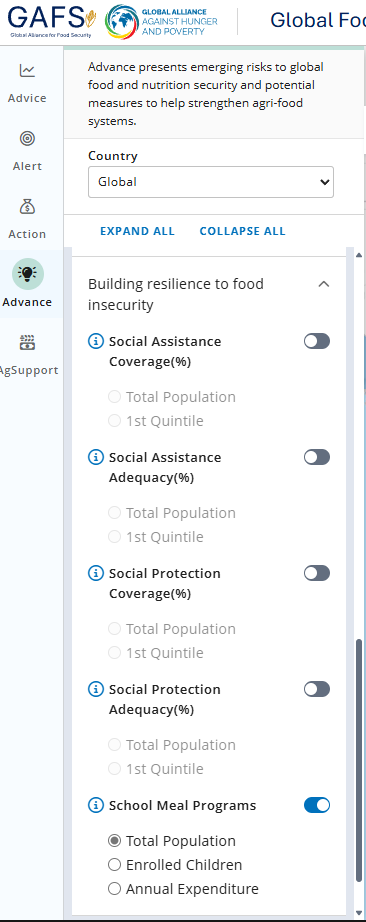
The partnership between the Global Child Nutrition Foundation (GCNF) and the World Bank represents a significant step toward addressing this gap. Through this collaboration, school feeding data from the Global Survey of School Meal Programs© is now integrated into both the Global Food and Nutrition Security (GFNS) Dashboard and the ASPIRE (Atlas of Social Protection: Indicators of Resilience and Equity) Social Protection Database. Now, school feeding data sits alongside other global information on poverty, nutrition, and social protection.
This work comes at a pivotal moment. In 2024, World Bank President Ajay Banga announced the institution’s ambition to extend social protection to an additional 500 million people by 2030. To achieve this, the World Bank’s “Big Bet” strategy places job creation and economic growth at the heart of development, focusing on sectors such as agribusiness, infrastructure, healthcare, tourism, and value-added manufacturing. In a time of shrinking fiscal space, leveraging every dollar to deliver maximum impact is more important than ever.
As this effort unfolds, data from GCNF helps the World Bank and governments make informed decisions and strengthen the return on their investments. School meals programs embody this vision: they are a concrete and scalable mechanism to link agriculture, social protection and education–turning public investment into a driver of jobs, markets, and human capital. When country data is placed in a global context, it becomes easier to compare, learn from others, and identify best practices. Countries can observe what works well elsewhere, refine their own programs, and make more informed decisions based on real evidence. By increasing visibility and accessibility of this data, the partnership supports civil society, governments, and researchers working to improve school feeding systems worldwide.
Connecting School Feeding to Global Systems
The integration of GCNF’s Global Survey of School Meal Programs© data into the World Bank’s GFNS Dashboard and ASPIRE represents a step forward in recognizing school meals as a central pillar of social protection and food systems.
Comprehensive, school-age-specific data on school feeding is now available alongside other key indicators of social protection and nutrition security. This not only helps bridge gaps between agriculture and social protection units within the World Bank, but also ensures that food and nutrition outcomes are prioritized within national and global investment planning.
Access to clear, validated, and sex-disaggregated data is also essential for ensuring equity in program design. Tracking coverage by gender helps governments ensure that girls are not being left behind, reinforcing the role of school meals in supporting inclusive development. It also helps benchmark countries’ progress on School Meal and Nutrition-Sensitive Social Protection programming.
Collaboration in Action: How the Partnership Came to Life
The collaboration between the World Bank and GCNF reflects a shared commitment to improving data quality and usability across global systems. The process of integrating the Global Survey of School Meal Programs© data required close coordination and technical exchange, an effort that both strengthened the data and created valuable learnings for future survey rounds.
“This collaboration between the World Bank and GCNF is meaningful for several reasons,” shared Ayala Wineman, Research Scientist for the Global Child Nutrition Foundation (GCNF). “First, we’re so pleased to see the Global Survey of School Meal Programs data included in other relevant databases wherever detailed data on school feeding can enrich the database’s offerings. School meal programs play an important role in social protection, and that role should be recognized, elevated, and celebrated. Second, we’re proud to see the Global Survey of School Meal Programs data positioned within such a valuable and well-recognized resource as the ASPIRE. Our goal is to see this treasure trove of school feeding data institutionalized in various domains and made more visible and accessible to all sorts of users.”
The collaboration also underscores the cross-sectoral nature of school feeding.
“There are so many links between school meal programs and other topics and sectors, ranging from nutrition to agriculture to education,” Wineman continued. “We’d love to see the Global Survey of School Meal Programs data included in additional databases wherever this link ought to be highlighted.”
Through this process, the Global Survey of School Meal Programs© has been “institutionalized” within respected global data systems, helping ensure that school feeding data continues to inform decision-making and investment planning well into the future.
The Impact of ASPIRE: Strengthening Social Protection Data
The ASPIRE database (Atlas of Social Protection Indicators of Resilience and Equity) is the World Bank’s premier compilation of social protection microdata and indicators, used to analyze the scope and performance of social protection systems worldwide. Covering over 140 countries, ASPIRE provides indicators drawn from administrative data and nationally representative household surveys, tracking how social protection programs evolve and perform over time. ASPIRE indicators are publicly available, and along with the International Labour Organization (ILO), are one of two data sources to monitor Target 1.3 of the Sustainable Development Goals “Implement nationally appropriate social protection systems and measures for all, including floors, and by 2030 achieve substantial coverage of the poor and the vulnerable.”
“Through this collaboration, ASPIRE will obtain comprehensive and up-to-date data on school feeding programs, enabling more accurate estimates of total social assistance expenditure and ensuring that this information is more broadly disseminated within and beyond the World Bank,” said Claudia Rodríguez, Senior Social Protection Specialist at the World Bank.
“The collaboration between the World Bank and GCNF marks the first step in a broader ambition: incorporating a set of globally recognized nutrition-sensitive social protection indicators into an open-source platform,” said Mia Blakstad, Social Protection Specialist, the World Bank. “The data are crucial because they enable governments to benchmark progress, showcase commitments, and compare approaches in ending malnutrition.”
This step aligns with the World Bank’s broader efforts to strengthen its commitment to nutrition across social protection programs. . “The World Bank is working to systematically identify the most impactful entry points for nutrition-sensitive approaches within its 30-billion-dollar social protection portfolio,” shared Dina Aburmishan, Nutrition Specialist, Consultant, the World Bank. “This work includes direct support for countries to maximize the nutritional impact of all social protection instruments like cash transfers, jobs and skills creation, and, importantly, food-based safety nets like school meals.”
The collaboration between GCNF and the World Bank will provide a framework on how to integrate social protection and nutrition beyond programming–into data analytics.
The Impact of the GFNS Dashboard: A Global Public Good
Alongside ASPIRE, GCNF’s Global Survey of School Meal Programs© data is also featured in the Global Food and Nutrition Security (GFNS) Dashboard, a global public good developed by the World Bank in collaboration with over 45 international partners.
The GFNS Dashboard brings together fragmented food and nutrition security data into a single, interactive platform designed to inform decision-making, policy development, and humanitarian response. With more than 50 indicators, it captures diverse dimensions from food insecurity and nutrition outcomes, to financing needs and social protection coverage.
“The inclusion of school feeding data in the GFNS Dashboard offers a powerful lens to understand how food-based social protection programs contribute to global food and nutrition security goals,” shared Namesh Nazar, Agriculture Economist, the World Bank.
This new data integration will also help the World Bank in supporting the ambitions of the Global Alliance Against Hunger and Poverty (GAHP), launched under the G20, by strengthening the global evidence base on how school feeding programs help countries reduce hunger, build resilience, and promote equitable food systems. Together, GCNF, GNFS and ASPIRE data can create a powerful foundation for governments and partners to track, benchmark and expand climate-smart, nutrition-sensitive school meal programs within broader efforts to end hunger and poverty by 2030.
Looking Ahead: A Growing Opportunity for Global Learning
The integration of GCNF’s Global Survey of School Meal Programs© data into ASPIRE and the GFNS Dashboard marks the first step in a broader process. Work is now underway to incorporate findings from the third round of the Global Survey of School Meal Programs©, providing an even more complete global picture.
When school feeding data is visible, it becomes actionable. By making school feeding data accessible and comparable, GCNF and the World Bank are helping governments design programs that reach more children, strengthen food systems, and turn every school meal into an investment in the future.
About the Organizations
Global Child Nutrition Foundation (GCNF)
The Global Child Nutrition Foundation (GCNF) is a US-based 501(c)3 organization founded in 2006 that envisions a future where school meals sustainably nourish all children and help them, their families, communities, and nations to thrive. GCNF provides governments and their partners with knowledge, tools, and connections so all children can access high-quality school meal programs that contribute to national educational, agricultural, economic, social protection, health and nutrition goals.
The World Bank is like a cooperative, made up of 189 member countries. These member countries, or shareholders, are represented by a Board of Governors, who are the ultimate policymakers at the World Bank. Generally, the governors are member countries’ ministers of finance or ministers of development. They meet once a year at the Annual Meetings of the Boards of Governors of the World Bank Group and the International Monetary Fund.








No comment yet, add your voice below!