
Collective Effort for a Brighter Future: Indonesia’s Journey Toward Free Nutritious Meals
Blog by: Arfisha Muwahidah, GCNF Intern, MSPH Student at Johns Hopkins Bloomberg School of Public Health
“My students could not bring meals to school because they only have one time to eat in a day”, shared a teacher from a junior high school in Bandung City, West Java—the heart of Indonesia’s most populated province.
This simple statement reveals a complex truth: solving nutrition and health challenges requires more than one solution. It requires multiple, coordinated, and thoughtfully designed interventions working in partnership across sectors. It takes a village, as they say. This is the story of how Indonesia came to understand that lesson —and what they did about it.
The data shows how serious the problem is. According to the GENIUS program—a prior school feeding program run by Indonesia’s National Food Agency (Bapanas)—47.1 percent of school-aged children did not eat or rarely ate breakfast.
The 2022 Indonesian student health survey found that about 76.78 percent of students consumed fewer than the recommended five portions of fruits and vegetables per day. More than half of students, 54.41 percent, consumed fast food at least once in the past seven days, and 62.34 percent of students regularly consumed sugary carbonated beverages. These eating habits contribute to poor diet quality and have consequences for health and learning outcomes.

Without action, these eating habits will get worse and affect students’ health and nutrition. Poor nutrition during childhood and adolescence leads to stunted growth, weaker immune systems, and lower capacity to learn. For adolescent girls, the stakes are even higher—poor nutrition now can lead to poor maternal and child health later.
Indonesia’s government is taking this seriously, recognizing treating child nutrition as a national priority. Childhood malnutrition today means reduced economic productivity tomorrow. The Human Capital Index is below the targets, and stunting prevalence and maternal mortality rate remain high. However, the problem is not just health nutrition—it’s education, it’s economics, it’s social protection. All these sectors must work together to find lasting solutions.
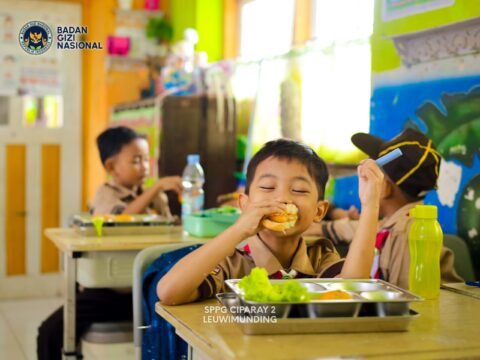
Indonesia’s school meal program, Makan Bergizi Gratis or MBG (Free Nutritious Meal), was officially launched on January 6, 2025 in 26 provinces with about 600 students receiving meals on day one. Since then, it has grown quickly. By early November 2025, the program had reached more than 41.2 million people—which is about 50 percent of the goal of 82.9 million. Beneficiaries include school students, early childhood, pregnant and breastfeeding women.
MBG was designed as a national strategy to achieve health and nutrition gains, better education, economic benefits, and social protection—all at the same time. In pilot areas, the program showed clear improvement in eating patterns. Students who used to buy packaged snacks now have fresh, healthy meals with vegetables and proteins. More importantly, they’re learning what good nutrition looks like. Children who used to eat rice with noodles—both carbohydrates—now bring meals with balanced nutrients that they’ve learned about every day at school. Moreover, teachers have noticed significant changes. Students attend school more regularly, are more attentive in class, and the learning environment is better.

Benefits of the program extend far beyond schools. MBG has supported the community by creating approximately 600,000 jobs, encompassing workers in kitchens and raw material suppliers. The vegetables from local farmers are purchased regularly, helping them have stable prices and steady income. Meanwhile, families experience financial relief as burdensome food expenses are now covered.
As the program scaled up, maintaining food safety became a critical focus. Rapid expansion led to some food poisoning incidents, prompting the government to act quickly. The government took corrective actions by closing more than 50 kitchens that were identified as causing food poisoning and health problems while waiting for laboratory tests from BPOM (Indonesia’s National Agency of Drug and Food Control). The government introduced stricter verification processes and required Hygiene and Sanitation Eligibility Certificates (SLHS) for all service units, demonstrating their commitment to quality assurance and food safety standards.
The government established nutrition standards that are tailored to different age groups, ensuring meals provide 20 to 35 percent of dietary needs, with specific amounts of carbohydrates, proteins, fats, vitamins, and minerals. MBG follows the “Isi Piringku” (My Plate) guidelines, which means balanced nutrition with whole foods in the right proportions. The government has also developed food safety protocols that cover the entire supply chain from receiving ingredients to storage to cooking to serving. The “5 Keys of Food Safety” framework is clear: use clean water, select safe raw materials and cook properly, separate raw from cooked food, maintain safe temperatures, and practice handwashing.

These guidelines and standards provide the foundation, but implementation requires continuous and systematic monitoring, regular inspections, and continuous capacity building through a clear regulation. To make MBG work well at scale, Indonesia could draw lessons from Brazil’s National Council for Food and Nutrition Security (CONSEA), which brings together representatives from different government agencies and civil society organizations to oversee the Programa Nacional de Alimentação Escolar (PNAE, the national school feeding program). This collaborative council ensures that food safety supervision, program delivery, and policy decisions are coordinated across sectors rather than managed by a single ministry. The success of Brazil’s sustained large-scale school feeding program shows what strong cross-sector collaboration can achieve.
Indonesia’s Free Nutritious Meal Program demonstrates what can happen when every sector plays its part—education provides the space, health ensures safety, agriculture supplies the food, and communities lend their hands. Together, they are shaping a brighter future for millions of children.
Photo Source: Ciparay Leuwimunding 1




No comment yet, add your voice below!